RAG types
Supported RAG types
rag-titan supports 2 RAG types. Every one has the same methods,
answer(question) and run(question), and with
RAGTitan you pick one using rag_type.
| Status | RAG type | How it works | Best for | LLM calls |
|---|---|---|---|---|
| ✅ Available | Simple RAGrag_type="simple" |
Retrieve → Rerank → Generate | Fast answers to clear questions | 1 |
| ✅ Available | Adaptive RAGrag_type="adaptive" |
Route → Retrieve → Check evidence → Rewrite & retry | Mixed questions, fewer wrong answers | 2–5 |
from rag_titan import RAG_TYPES, RAGTitan

print(RAG_TYPES)                      # ['simple', 'adaptive']
rag = RAGTitan(rag_type="adaptive")   # any value from RAG_TYPES
Asking for a type that does not exist yet raises a clear error:
ValueError: Unknown RAG type: graph. Choose from ['simple', 'adaptive']
See Planned RAG types for what is coming next.
Simple RAG ("simple")
Question -> Retrieve -> Rerank -> Generate
The classic RAG. It searches once and answers once.
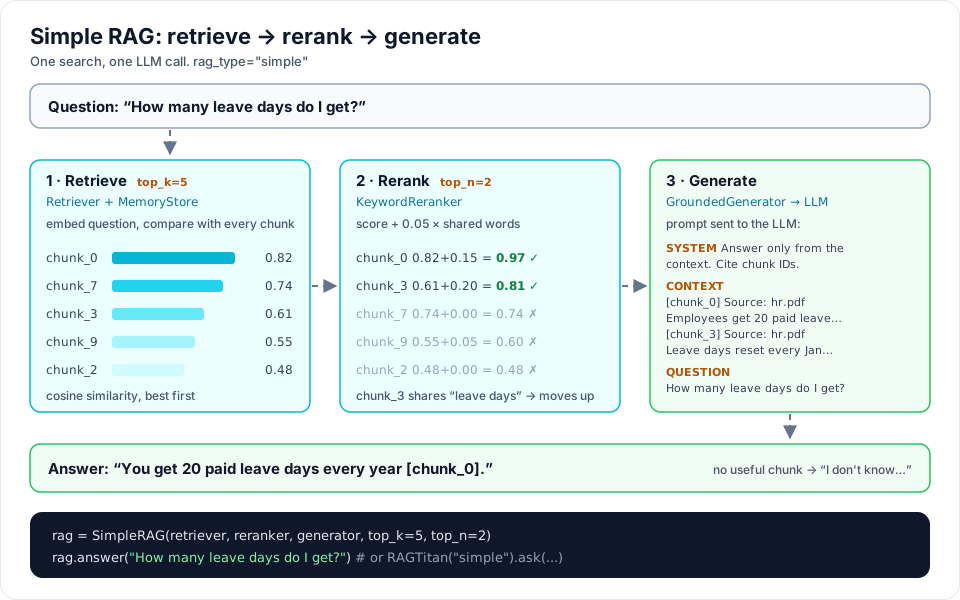
- Good for: clear factual questions, fast answers, learning how RAG works.
- LLM calls per question: 1
- Options:
top_k(chunks to retrieve, default 5),top_n(chunks to keep, default 2)
from rag_titan import SimpleRAG

rag = SimpleRAG(retriever, reranker, generator, top_k=5, top_n=2)
Adaptive RAG ("adaptive")
Question -> Choose route -> Retrieve -> Rerank -> Check evidence
                                                 |
                                 Enough evidence -> Answer
                                                 |
                             Not enough -> Rewrite and retry
It decides how much work each question needs:
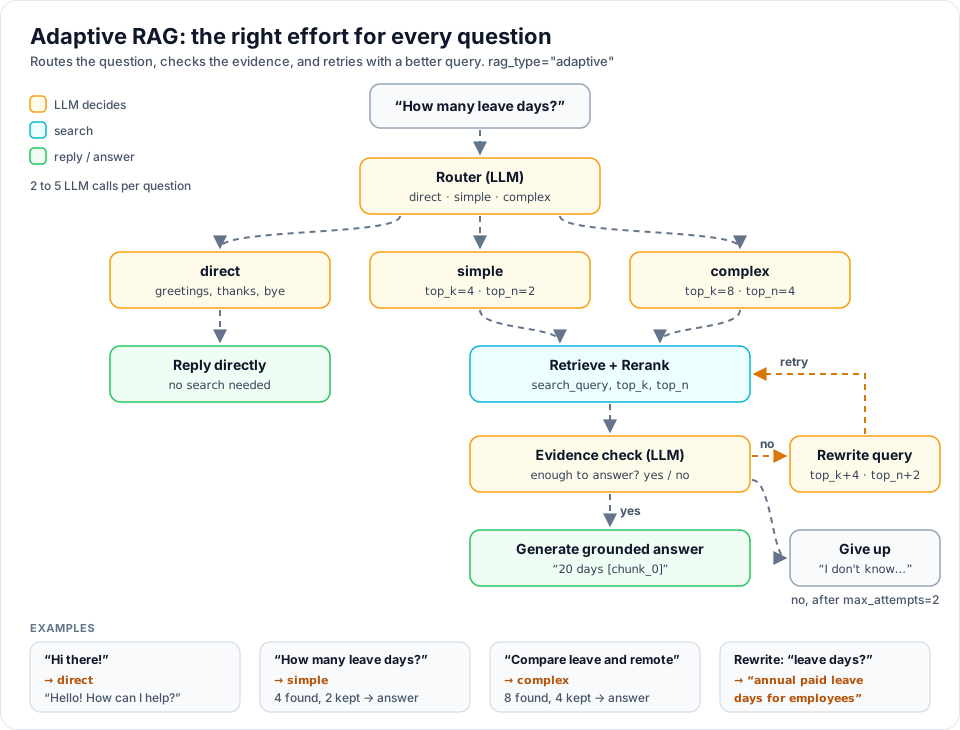
| Route | When | What it does |
|---|---|---|
direct |
greetings, thanks, goodbyes | replies without searching |
simple |
one-topic factual question | small search (top_k 4, top_n 2) |
complex |
comparisons, multi-part | bigger search (top_k 8, top_n 4) |
After searching, the LLM checks if the chunks really answer the question. If
not, the question is rewritten into a better search query and the search is
made wider. After max_attempts (default 2) it says it does not know.
- Good for: mixed questions, avoiding wrong answers.
- LLM calls per question: 2 (greeting) to 5 (one retry), with the default
max_attempts=2 - Parts:
Router,EvidenceChecker,QueryRewriter
Comparing RAG types
from rag_titan import RAG_TYPES, build_rag, build_rag_parts, get_settings

parts = build_rag_parts(get_settings())
parts["pipeline"].run(["handbook.pdf"])        # index once

for rag_type in RAG_TYPES:
    print(rag_type, build_rag(rag_type, parts).answer("How many leave days?"))
Seeing every step: run()
answer() returns only the text. run() also returns the chunks used and
every step the RAG type took, with its input, output and time:
from rag_titan.rag_types import describe_steps

result = rag.run("how many leave days?")
result["answer"]     # same text as rag.answer(...)
result["sources"]    # the chunks given to the generator
result["steps"]      # [{"step": "route", "input": {...}, "output": "simple", "ms": 412.0}, ...]

print(describe_steps(result["steps"]))
With RAGTitan, rag.run(question) gives the same dict plus "log", the
readable text below: print(rag.run("how many leave days?")["log"]).
Adaptive RAG that did not find enough evidence the first time, then rewrote the query and searched wider (timings from a test with a fake LLM):
1. route        0.00 ms  query='how many leave days?'
                         -> 'simple'
2. retrieve     0.06 ms  query='how many leave days?', top_k=4
                         -> 3 chunks: chunk_0 hr.pdf (0.707), chunk_1 hr.pdf (0.000), chunk_2 it.pdf (0.000)
3. rerank       0.01 ms  query='how many leave days?', matches=3 chunks, top_n=2
                         -> 2 chunks: chunk_0 hr.pdf (rerank 0.807), chunk_1 hr.pdf (rerank 0.000)
4. check        0.01 ms  query='how many leave days?', chunks=2 chunks
                         -> False
5. rewrite      0.00 ms  query='how many leave days?'
                         -> 'annual leave days per year'
6. retrieve     0.01 ms  query='annual leave days per year', top_k=8
                         -> 3 chunks: chunk_0 hr.pdf (1.000), chunk_1 hr.pdf (0.000), chunk_2 it.pdf (0.000)
7. rerank       0.01 ms  query='how many leave days?', matches=3 chunks, top_n=4
                         -> 3 chunks: chunk_0 hr.pdf (rerank 1.100), chunk_1 hr.pdf (rerank 0.000), chunk_2 it.pdf (rerank 0.000)
8. check        0.00 ms  query='how many leave days?', chunks=3 chunks
                         -> True
9. generate     0.00 ms  query='how many leave days?', chunks=3 chunks
                         -> 'You get 20 leave days [chunk_0]'
The flow of each RAG type
Every RAG type also describes its steps and the arrows between them in FLOW.
The steps that run() records always follow these arrows (a test checks it),
so a diagram can be drawn from FLOW and lit up with a real run.
from rag_titan import AdaptiveRAG

AdaptiveRAG.FLOW["nodes"][0]   # {"id": "route", "label": "Choose route", "kind": "llm"}
AdaptiveRAG.FLOW["edges"][:2]  # [["route", "direct_reply"], ["route", "retrieve"]]
kind is search, llm or output. The RAG playground
draws every RAG type from its FLOW and lights it up with a real run, in your
browser.
Planned RAG types
These are not available yet. They will be added as new rag_type values,
so code that uses RAGTitan keeps working.
| Status | RAG type | Idea |
|---|---|---|
| 🔜 Planned | Corrective RAG (CRAG) | Grade each chunk and fall back to web search when they are weak |
| 🔜 Planned | Multi-query RAG | Ask several versions of the question and merge the results |
| 🔜 Planned | HyDE | Write a hypothetical answer first, then search with it |
| 🔜 Planned | Hybrid RAG | Combine keyword (BM25) and vector search |
| 🔜 Planned | Self-RAG | The model checks and improves its own answer |
| 🔜 Planned | Parent-document RAG | Search small chunks, answer with the bigger section around them |
| 🔜 Planned | Graph RAG | Search a knowledge graph built from your documents |
| 🔜 Planned | Agentic RAG | An agent decides when and what to search |
Want one sooner? Open an issue or read Extending rag-titan. See the full roadmap.