RAG evaluation cookbook
FROM “IT ANSWERED” TO “I KNOW WHAT TO FIX”
Run your first evaluation. Read the evidence. Improve one thing.
Start with a small employee handbook and two questions. Then use the same workflow on your own RAG system. The first recipe needs only Python: no model, API key or GPU.
The whole workflow in one minute
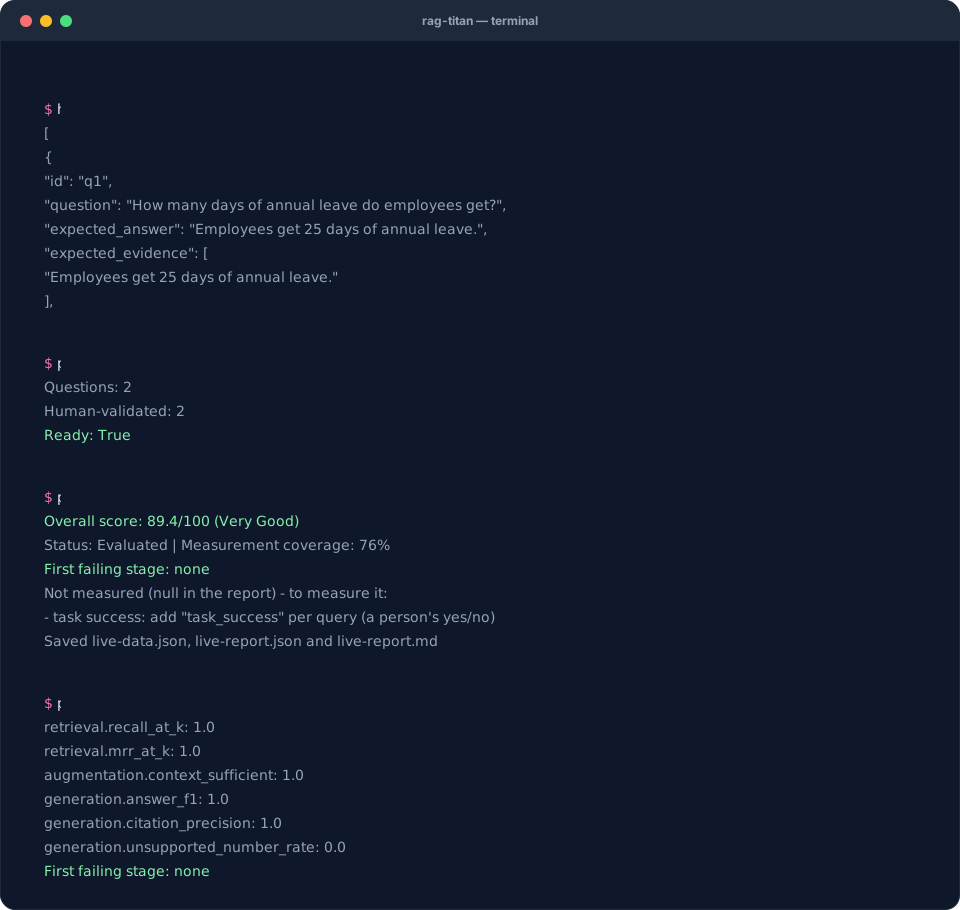
Recorded from a real run with Ollama (gemma3:4b, nomic-embed-text). Live answers vary, so your score may differ.
Choose your path
You only want to evaluate it. No model, GPU or API key is needed for this.
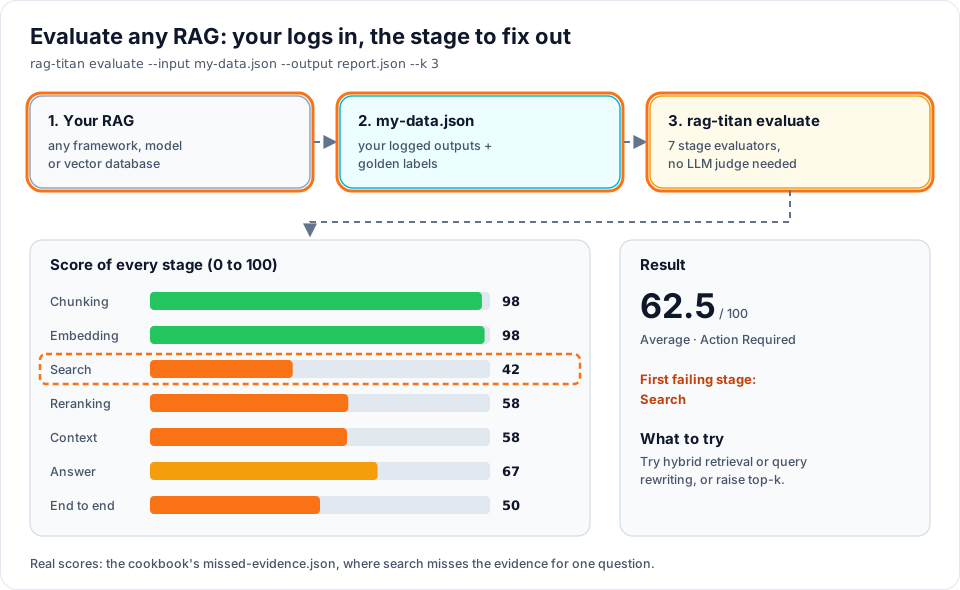
- Install:
pip install rag-titan - Write golden questions:
rag-titan golden --questions questions.txt --files your-docs.mdwrites a draft; you review it. → Build a golden set - Turn your RAG's logs into one data file with
build_dataset(). → Evaluate your own RAG - Score it:
rag-titan evaluate --input my-data.json --output report.json --k 3. You get a 0 to 100 score, the first failing stage, the queries to look at and what was not measured. - Score is low? Find which stage to fix. → Diagnose a bad answer
- Changed something? Compare with your last report. → Catch regressions
Learn the workflow on a tiny handbook first, with ready-made data.
- Your first evaluation: run one command, read three numbers.
- Diagnose a bad answer: see how a failing stage is found.
- Catch regressions: stop a worse version before it ships.
Then switch to the Already have a RAG? path with your own data.
RAG means finding pieces of your documents and giving them to a language model so it can answer a question. Evaluation means comparing what happened with what should have happened. A fluent answer alone does not tell you whether the system found the right evidence or used it correctly.
All recipes
| Your situation | Recipe | What you finish with |
|---|---|---|
| “I have never evaluated a RAG.” | 1. Your first evaluation | A JSON report and a readable Markdown report |
| “The answer is wrong. Where do I look?” | 2. Diagnose a bad answer | A stage to investigate and a concrete next experiment |
| “I changed something. Is it better?” | 3. Catch regressions | A baseline comparison and a command that fails on regression |
| “I already have my own RAG.” | 4. Evaluate your own RAG | Logged outputs in a portable evaluation format |
| “I want to run this on real models.” | 5. Evaluate a live rag-titan pipeline | Actual Ollama outputs, saved data and a stage report |
| “What should my test questions look like?” | 6. Build a golden question set | Reviewed questions, reference answers and evidence labels |
Follow recipes 1 → 2 → 3 first. Recipes 4 and 5 are alternative ways to collect your own data. Recipe 6 helps you make that data useful.
Download everything
Download the cookbook starter kit
The ZIP extracts into rag-titan-cookbook/. It contains input JSON files, expected
reports, a miniature handbook, reviewed questions and Python scripts. There is no
need to clone the repository. Start with installation and extraction.
Real computations; clearly labelled teaching data
The no-model examples use fictional company policies, hand-written answers and small toy vectors. The scores are computed by the real rag-titan evaluator, not invented for the animation. The live recipe actually calls Ollama; its answers and timings will vary. Two questions teach the workflow, not production quality.
Watch the evidence travel
Choose a failure, then press Play walkthrough or select an individual stage. Change K to see what happens when you score fewer retrieved results. The diagram shows q1; the metric cards average both questions.
The interactive walkthrough loads here. Without JavaScript, follow the same examples in Diagnose a bad answer.
Five words you need
| Term | Plain meaning | In this cookbook |
|---|---|---|
| Chunk | A piece of a document | c1 contains the annual-leave policy |
| Query | A question asked of the system | “How many days of annual leave?” |
| Gold label | A reviewed description of the correct result | expected_chunk_ids: ["c1"] |
| K | How many ranked results to score | K=3 checks the first three logged results |
| Baseline | A saved report you compare a later run against | baseline.json |
The input data describes documents, outputs and labels. The report contains
computed metrics. They are different files: pass input data to --input and a saved
report to --baseline.
How to trust the result
Read coverage → individual failures → overall score, in that order. An absent measurement is not zero, but it is also not a pass. Answer F1 measures word overlap; context grounding measures lexical overlap; citation scores compare IDs with labels. They do not establish that every claim is true. Review representative answers yourself.
Use the metric reference for formulas and the stage evaluation guide for the full data format. To run several chunker/RAG combinations, use Evaluating RAG.