6. Build a golden question set
Goal: create trustworthy reference questions so that your scores mean something. Requirements: source documents you understand and the starter installation from recipe 1. You do not need a model to write or check labels.
A golden set is a collection of questions with human-reviewed expected answers and supporting evidence. Your model's current answer is not automatically the truth. Write the reference from the source document, then compare the model with it.
What you will see
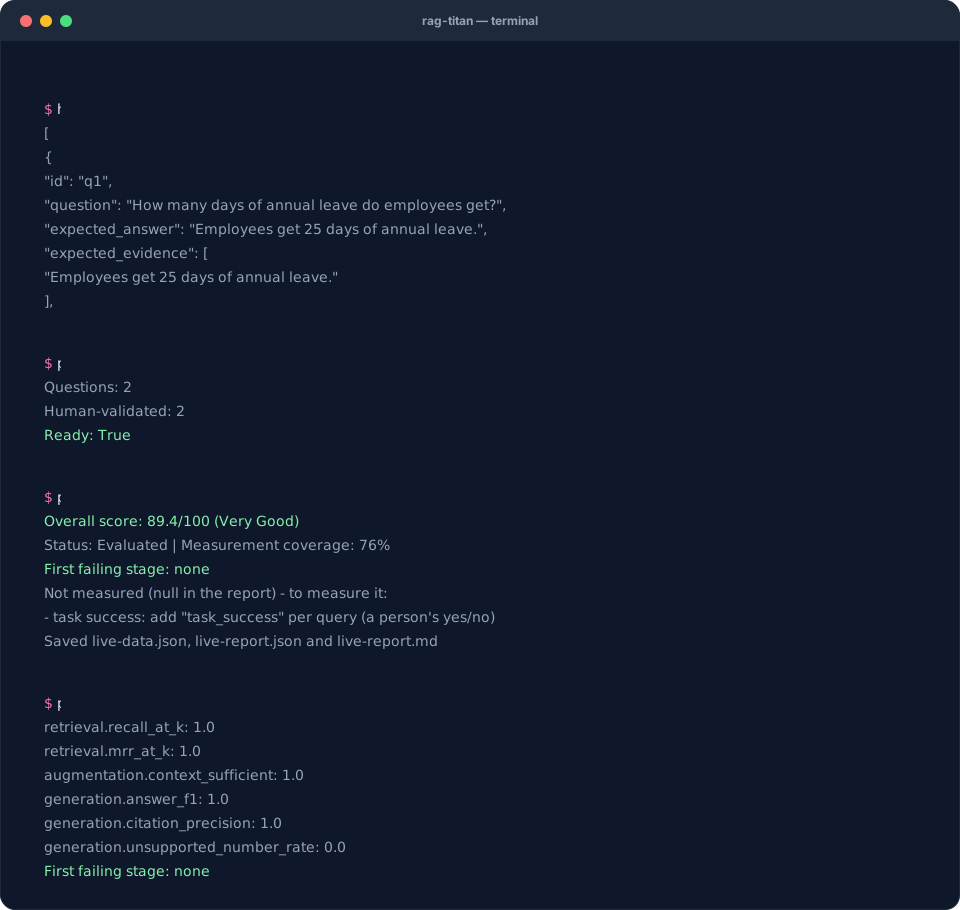
Recorded from a real run with Ollama (gemma3:4b, nomic-embed-text). Live answers vary, so your score may differ.
Prepare golden data step by step
A golden question is the answer you know is correct, written by you from the document. You do not have to start from an empty file: rag-titan writes a first draft, and you review it.
Step 1. List your questions, one per line, in questions.txt:
How much is the daily meal allowance?
Can I fly business class on a four-hour flight?
Step 2. Let rag-titan write the draft (with your documents, it suggests an evidence sentence for each question):
rag-titan golden --questions questions.txt --files travel_policy.md --output golden.json
Wrote golden.json: 2 questions, 2 with a suggested evidence quote.
Next: for every question, check the quote, write expected_answer and required_facts, then set validated to true.
Step 3. Review every record. Open golden.json and fill in what a person must decide:
| Field | What you do | Example |
|---|---|---|
expected_evidence |
Check the suggested sentence proves the answer; replace it if not | "Economy class is required for all flights under six hours." |
expected_answer |
Write the correct answer yourself, from the document | "No, economy class is required under six hours." |
required_facts |
1 to 3 words the answer must contain | ["economy"] |
answerable |
false if the documents do not answer it |
true |
validated |
Set to true only after you checked the record |
true |
The suggestion is only a draft
The suggested sentence is the one that shares the most words with the question.
For "Can I fly business class on a four-hour flight?" it suggests "Business
class is allowed for flights of six hours or longer.": related, but the
sentence that proves the answer is the economy one. That is why every
record starts with "validated": false.
Step 4. Check the file against your documents:
from pathlib import Path
from rag_titan.evaluation import check_golden

result = check_golden("golden.json", {"travel_policy.md": Path("travel_policy.md").read_text()})
print(result["ready"], result["problems"])
Ready: True means every question is reviewed, has an answer and evidence, and every
quote occurs exactly once in your documents. Until then problems says what is missing,
for example no expected_answer. The sections below explain each field in detail.
1. Write one complete question
This is a record from the downloadable golden.json:
{
  "id": "q1",
  "question": "How many days of annual leave do employees get?",
  "expected_answer": "Employees get 25 days of annual leave.",
  "expected_evidence": ["Employees get 25 days of annual leave."],
  "required_facts": ["25"],
  "answerable": true,
  "validated": true
}
The full file is a JSON list of such records, enclosed in [ and ].
| Field | Why it exists | How to write it |
|---|---|---|
id |
Joins the question across runs | A stable, unique ID such as q1 |
question |
What the user asks | Natural wording, not a copy of a document heading |
expected_answer |
Reference for answer metrics | A concise answer checked against the source |
expected_evidence |
Locates the supporting chunks | An exact quote that occurs once in the source set |
required_facts |
Checks key phrases | Short factual strings that should appear in the answer |
answerable |
Distinguishes answerable from unanswerable | Set based on the documents, not general knowledge |
validated |
Records human review | Set to true only after review |
required_facts uses text matching. It does not understand that two differently
worded claims mean the same thing. Use it alongside reference answers and manual review.
2. Check the starter questions
python check_golden.py
Expected: two questions, two human-validated records and Ready: True.
The included script calls:
from pathlib import Path
from rag_titan.evaluation import check_golden

result = check_golden("golden.json", {
    "handbook.md": Path("handbook.md").read_text(encoding="utf-8"),
})
print(result)
The checker finds missing answers or evidence, mismatched required facts, missing review flags and quotes not found exactly once in the supplied documents. It does not replace a person's judgement about correctness or whether the question is useful.
3. Deliberately break a label
Make a copy of golden.json before experimenting. Change q1's evidence quote to
“Employees get 30 days of annual leave.” while leaving the handbook unchanged.
Run check_golden.py again. It reports that the quote was not found exactly once,
prints Ready: False and exits with code 1.
Restore the original quote. Now change validated to false: the reviewed count
falls and Ready becomes false. Restore the original file before the live recipe.
4. Prefer evidence quotes when comparing chunkers
The live bridge maps expected_evidence quotes onto the chunks produced by the
current chunker. That is useful when chunk IDs change between configurations.
Check quote boundaries carefully: a quote split across chunks can label multiple
chunks as evidence.
You may provide explicit expected_chunk_ids when evaluating a fixed, known index.
A broad file label such as required_evidence_ids: ["handbook.md"] instead marks
every chunk of that file as gold in the stage bridge. That can make Recall@K
look low even when the relevant passage was retrieved. Use precise quotes or chunk
labels when you need passage-level recall.
5. Include questions the documents cannot answer
For example, the supplied handbook says nothing about a gym allowance:
{
  "id": "q3",
  "question": "What is the monthly gym allowance?",
  "answerable": false,
  "validated": true
}
Add this record to the list only after confirming the information is absent.
Do not invent evidence. The desired behavior is to acknowledge that the documents
do not supply an answer. When logging another system, record its abstained value
accurately so abstention accuracy can be measured. The rag-titan bridge recognizes
its supported refusal strings; inspect unfamiliar refusals yourself.
6. Grow beyond the tutorial
Start from actual user questions and cover different failure modes:
- Direct lookups: one passage clearly answers the question.
- Multiple facts: two passages are both needed.
- Similar policies: the system must distinguish leave from sick pay.
- Exceptions: the answer changes under a stated condition.
- Unanswerable questions: the source does not provide the requested fact.
Keep a separate held-out set for final comparisons. If you repeatedly tune the system against the same questions, success may reflect memorizing that set rather than improving for new users. Version the questions with the documents, and record who reviewed them and when in your own review process.
Dataset helpers such as profile_documents() and sample_documents() can help
find empty/duplicate documents and select review samples. Their API is documented
in Evaluating every stage; they do not create verified
answers for you.
Next: run your reviewed set on a live pipeline, then save a baseline.