Evaluating RAG
New to evaluation? Start with the evaluation cookbook: runnable examples, animated stage walkthroughs and command builders for your terminal.
A RAG answer can only be as good as the chunks it is given. Before you change the chunker, the retriever or the RAG type, measure how well it works on your own questions, then compare. No method is best for every set of documents.
This page compares setups (chunkers and RAG types). To score each stage of one pipeline (chunking, embedding, retrieval, reranking, context and answers), or to evaluate a RAG system that is not built with rag-titan, see Evaluating every stage.
The easy way
1. Write a questions file. For each question, name the file (or page) that holds the answer (format):
[{"id": "q_001", "question": "How many paid leave days do I get each year?",
  "required_evidence_ids": ["leave_policy.md"]}]
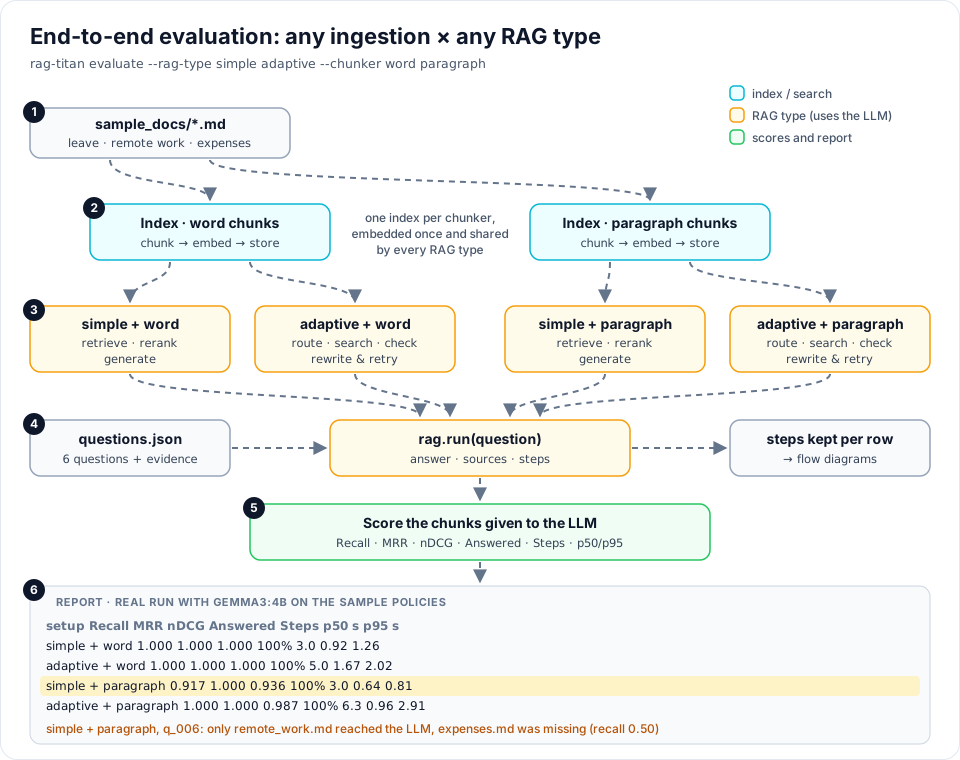
2. Compare any ingestion with any RAG type, end to end (uses the LLM):
rag-titan evaluate --files docs/*.md --questions questions.json \
    --rag-type simple adaptive --chunker word paragraph
End-to-end report: 6 questions (evidence scored on the chunks given to the LLM)

setup                   Recall       MRR      nDCG  Answered     Steps     p50 s     p95 s
------------------------------------------------------------------------------------------
simple + word            1.000     1.000     1.000      100%       3.0      0.92      1.26
adaptive + word          1.000     1.000     1.000      100%       5.0      1.67      2.02
simple + paragraph       0.917     1.000     0.936      100%       3.0      0.64      0.81
adaptive + paragraph     1.000     1.000     0.987      100%       6.3      0.96      2.91

Questions to look at:
  simple + paragraph: q_006  recall 0.50  found ['remote_work.md']
Every --rag-type is tried with every --chunker (here 2 × 2 = 4 setups).
Setups with the same chunker share one index, so the files are embedded once
per chunker.
3. See why one question went wrong, step by step:
rag-titan ask --files docs/*.md --trace \
    --question "Can I work from Spain for a month?"
1. retrieve     7.47 ms  query='Can I work from Spain for a month?', top_k=5
                         -> 3 chunks: chunk_2 remote_work.md (0.615), chunk_0 expenses.md (0.540), ...
2. rerank       0.04 ms  query='Can I work from Spain for a month?', matches=3 chunks, top_n=2
                         -> 2 chunks: chunk_2 remote_work.md (rerank 0.815), chunk_0 expenses.md (rerank 0.690)
3. generate   567.39 ms  query='Can I work from Spain for a month?', chunks=2 chunks
                         -> "I don't know based on the available documents."
Search did give the LLM remote_work.md, which allows 20 working days
abroad, and the LLM still said it does not know: the problem is the answer
step, not the search. Try a bigger model or another prompt, not another chunker.
The same in Python:
from rag_titan import RAGTitan

rag = RAGTitan(rag_type="adaptive", settings={"chunker": "paragraph"})
rag.index(["leave_policy.md", "remote_work.md", "expenses.md"])

rag.evaluate("questions.json")                    # end to end, uses the LLM
rag.evaluate_retrieval("questions.json", top_k=3) # search only: fast, no LLM
print(rag.run("Can I work from Spain?")["log"])   # every step
All numbers on this page come from real runs with gemma3:4b and
nomic-embed-text on the three sample policies in examples/sample_docs/.
LLM replies change a little between runs, and 6 questions only show how the
tools work: for a real decision, write 30 to 100 questions (see tips).
Comparing setups in Python
from rag_titan.evaluation import compare_setups, format_rag_report

results = compare_setups(
    files=["leave_policy.md", "remote_work.md", "expenses.md"],
    questions="questions.json",
    setups=[
        {"name": "simple + word", "rag_type": "simple", "settings": {"chunker": "word"}},
        {"name": "adaptive + paragraph", "rag_type": "adaptive",
         "settings": {"chunker": "paragraph", "chunk_size": 300, "chunk_overlap": 0}},
    ],
)
print(format_rag_report(results))
settings can change any setting: chunker, chunk size,
models, reranker. Each result has the averages and one row per question with
the answer, the files given to the LLM and every step of run().
| Column | Meaning |
|---|---|
| Recall, MRR, nDCG | scored on the chunks given to the LLM (sources of run()), see the metrics |
| Answered | share of questions not answered with "I don't know..." |
| Steps | average number of steps per question: loops and retries cost time |
| p50 s, p95 s | time per question, including the LLM |
When a RAG type gives up (Adaptive RAG after a failed evidence check) no chunks reach the LLM, so that question scores 0 even if the search found the file. To grade whether the answer itself is correct (answer F1, required facts, citations), use Evaluating every stage.
Search only (no LLM)
Retrieval alone is much faster and does not depend on the LLM, so it is the quickest way to compare chunkers and retrievers:
from rag_titan.evaluation import compare_retrievers, format_report, load_questions

questions = load_questions("questions.json")
results = compare_retrievers({"dense": retriever}, questions, top_k=5)
print(format_report(results))
Retrieval report: 6 questions, top_k=3

retriever        Recall@3       MRR    nDCG@3    p50 ms    p95 ms
-----------------------------------------------------------------
dense               1.000     1.000     0.987       7.0       8.5
dense_no_dedupe     1.000     1.000     0.987       7.1       8.4
This is the real output of python examples/evaluate_retrieval.py. It indexes
three short policies in examples/sample_docs/ with Ollama embeddings and
compares the default retriever with one that keeps near-copies.
The questions file
A JSON list. Each record says which evidence a good search must find:
[
  {"id": "q_001",
   "question": "How many paid leave days do I get each year?",
   "required_evidence_ids": ["leave_policy.md"],
   "task_type": "fact"},
  {"id": "q_006",
   "question": "What do I get for working from home: equipment and money for furniture?",
   "required_evidence_ids": ["remote_work.md", "expenses.md"],
   "task_type": "multi_hop"}
]
| Key | Needed | Meaning |
|---|---|---|
id |
yes | a unique name, used in error messages and in the rows |
question |
yes | what to search for |
required_evidence_ids |
yes | one or more evidence ids (below); a multi-hop question lists several |
task_type |
no | your own label, like fact, semantic, multi_hop |
| anything else | no | kept as it is (for example answer or tenant) |
load_questions() checks every record and says which one is wrong:
ValueError: Question 'q_007': Evidence id 'hr.pdf#4': write the page as '#p4'
Evidence ids
| Evidence id | A chunk is evidence when |
|---|---|
"hr.pdf" |
it comes from hr.pdf |
"hr.pdf#p4" |
it comes from hr.pdf and its page_numbers include 4 |
Evidence ids name files and pages, not chunk ids. Chunk ids (chunk_0,
chunk_1, ...) change whenever you change the chunker, so labels written with
them would break. With files and pages you can compare chunkers on one file.
Each evidence counts once: when two overlapping chunks come from the same page, only the first one counts, so near-copies never make a retriever look better.
The metrics
Every metric is from 0 (bad) to 1 (perfect), computed for each question on the first \(k\) results, then averaged.
| Metric | Formula | Answers the question |
|---|---|---|
| Recall@k | \(\dfrac{\lvert \text{Relevant} \cap \text{Retrieved}_k \rvert}{\lvert \text{Relevant} \rvert}\) | did we find all the evidence? |
| MRR | \(\dfrac{1}{N} \sum_q \dfrac{1}{\text{rank}_q}\) | how high is the first piece of evidence? |
| nDCG@k | \(\dfrac{\sum_r g_r / \log_2(r+1)}{\text{IDCG}}\) | is the evidence near the top? |
| p50 / p95 ms | median and 95th percentile time per search | how fast, including the slow searches |
For nDCG, \(g_r\) is the number of new evidences found at rank \(r\), and IDCG is the best possible score: one new evidence at each of the first \(\min(\lvert \text{Relevant} \rvert, k)\) ranks. One chunk can hold two evidences (pages 4 and 5), so the score is capped at 1.
Worked example. A question needs a.pdf#p4 and c.txt. The search returns:
| Rank | Chunk from | New evidence |
|---|---|---|
| 1 | a.pdf page 1 |
– |
| 2 | b.pdf page 2 |
– |
| 3 | a.pdf page 4 |
a.pdf#p4 |
| 4 | a.pdf page 4 again |
– (already found) |
| 5 | c.txt |
c.txt |
- Recall@5 \(= 2/2 = 1.0\), but Recall@3 \(= 1/2 = 0.5\)
- reciprocal rank \(= 1/3\) (first evidence at rank 3)
- nDCG@5 \(= \dfrac{1/\log_2 4 + 1/\log_2 6}{1 + 1/\log_2 3} = \dfrac{0.887}{1.631} \approx 0.544\)
Latency is reported as p50 and p95, not only an average: the average hides the few slow searches that users notice.
Retrieval results in Python
evaluate_retriever() returns the averages and one row per question, so you
can find the questions that fail:
from rag_titan.evaluation import evaluate_retriever

result = evaluate_retriever(retriever, questions, top_k=5)
result["recall"], result["mrr"], result["ndcg"], result["p95_ms"]

for row in result["rows"]:
    if row["recall"] < 1:
        print(row["id"], row["task_type"], row["sources"])
compare_retrievers({"name": retriever, ...}, questions, top_k) runs every
retriever on the same questions with the same top_k, and returns one such
result per retriever.
Tips
- Write 30 to 100 questions for each kind of question that matters to you. A handful of questions is a smoke test, not proof that one method is better.
- Include questions that need several pieces of evidence: a single label per question hides weak multi-hop retrieval.
- Use page labels (
#p4) for long PDFs: a file label is too easy to match. - Compare under identical conditions: same files, chunker, embedder and
top_k.
To grade the answers themselves (correctness, citations, grounding) and get a 0 to 100 scorecard, continue with Evaluating every stage.